Druids temple
Druids temple in North Yorkshire
HERITAGE AND HISTORYHIDDEN GEMS
The Druid’s Temple: North Yorkshire’s Mini Stonehenge Hidden in the Wood
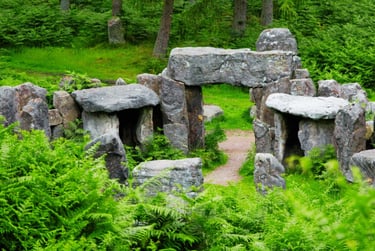
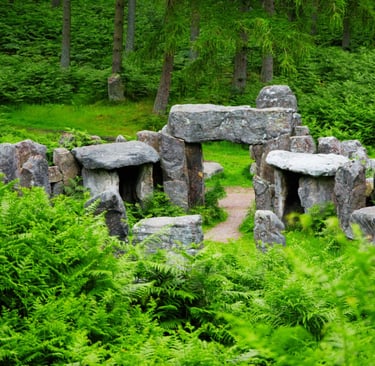
If you wander up into the woodland above Swinton Estate near Masham, you’ll eventually come across something that feels wildly out of place — a brooding ring of monolithic stones rising out of the trees like a scene from ancient Britain. Locals call it The Druid’s Temple, and at first glance you’d swear it was Neolithic. But this “mini Stonehenge” isn’t prehistoric at all. It’s Georgian. And its story is wonderfully eccentric.
A Temple Built in 1803 — Not 3000 BC
The Druid’s Temple was commissioned in 1803 by William Danby, the then‑owner of Swinton Estate. Danby was an eccentric man of letters — a published author, a thinker, and someone deeply interested in moral philosophy and ancient belief systems. At a time when Britain was gripped by a romantic fascination with paganism, mysticism, and the natural world (think Shelley, Blake, and the early Romantics), Danby decided to build his own stone temple.
Partly, it was a personal passion project. But it was also practical: the early 1800s were a time of hardship in the area, and Danby used the construction as a way to provide employment for local workers. A philanthropic folly, if you like.
A Monumental Undertaking
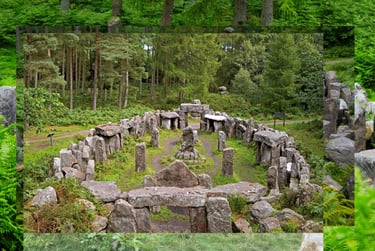
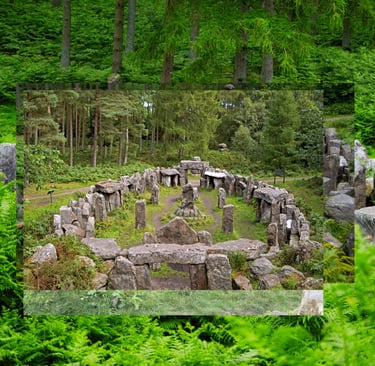
Walking among the stones, you can’t help but marvel at the sheer effort involved. They’re not as colossal as Stonehenge, but they’re still seriously heavy slabs of gritstone, arranged in chambers, circles, and passageways. No one knows exactly where the stones came from — perhaps a local quarry, perhaps dragged from elsewhere on the estate — but however they arrived, setting them upright in the forest was no small feat.
I was listening to local guide Felicity Lister, and she described it perfectly: “They’re very large pieces of stone… this must have been a major undertaking at the time.” And they’ve stood here, weathering the Yorkshire seasons, for more than two centuries.
A Temple with Symbolism Built In
The layout isn’t random. If you know what to look for, the symbolism becomes clear:
A large central chamber
Representations of the four classical elements — Air, Earth, Wind, and Fire
A central phallus stone
A solar chamber beyond, with a small cavern known as the “tomb of transformation”
It’s theatrical, esoteric, and very much in keeping with the Georgian and Victorian love of follies — though most landowners settled for a turret or a mock ruin, not a full‑blown pagan temple.
Danby: A Curious Character
Danby travelled widely, collected ideas, and embraced the philosophical trends of his time. Though known as a pious Christian, he was fascinated by belief systems of all kinds. The Druid’s Temple reflects that curiosity — a blend of scholarship, imagination, and a desire to create something both meaningful and mysterious.
And mysterious it certainly is.
A Hermit for Hire
One of the strangest footnotes in the temple’s history is Danby’s attempt to hire a full‑time hermit to live on the estate. The contract was for seven years. The hermit lasted four. Whether he grew tired of the solitude or simply had enough of the damp Yorkshire weather, we’ll never know — but the idea alone tells you everything about Danby’s flair for the dramatic.
A Film Set in the Making
Visit today and you’ll understand why filmmakers and musicians love it. The place has a cinematic quality — atmospheric, slightly eerie, and perfect for anything leaning into folklore or the uncanny. A band called Hedge even filmed a music video here, embracing the wild, ritualistic vibe of the setting.
Visiting the Druid’s Temple
The temple sits within the woodland of the Swinton Estate, a short drive from Masham. It’s free to visit, though parking is usually via the estate’s facilities. The walk is gentle, the atmosphere unforgettable, and the moment you step into the stone circle, you’ll feel that strange blend of history, imagination, and theatricality that Danby created.
It’s not ancient. It’s not truly Druidic. But it is one of North Yorkshire’s most intriguing follies — a place where Georgian eccentricity meets timeless woodland mystery.
Ad: Yorkshire Insider is a participant in affiliate advertising programs. We may earn a commission from qualifying purchases made through our links at no extra cost to you.
How to Get to the Druid’s Temple (Mini Stonehenge), Swinton Estate
The Druid’s Temple sits in the woodland above Swinton Estate near Masham, and although it feels remote, it’s straightforward to reach by car. The most reliable postcode for sat‑nav is:📍 HG4 4JZ.
Driving Directions
From the A1(M)
The clearest approach is via the A1(M):
Exit at Junction 50 (A61 / A6055).
Take the A6055 for around 3 miles.
At the roundabout, take the first exit onto the B6267.
Continue for 6.8 miles.
Turn left onto Fearby Road.
After 2.4 miles, turn left onto Riggs Bank.
After 0.5 miles, turn right.
After 0.3 miles, turn left onto Ilton Bank, then right onto Knowle Lane.
Follow the lane until you reach the signposted car park for the Druid’s Temple.
Parking is usually via an honesty box (£3), and there are toilets and a small cafe nearby.
From the Car Park to the Temple (On Foot)
The temple cannot be accessed by car beyond the car park — the road is private.
Follow the signposted footpath towards “Druid’s Temple.”
The walk is gentle, with a slight incline at the start.
Expect around 15 minutes of walking through woodland.
You’ll first reach an information board, then the path leads directly into the forest where the stone structures appear.
Public Transport?
There is no direct public transport to the temple itself. The nearest options are:
Masham (bus‑served from Ripon, Bedale, Leyburn, Richmond)
From Masham, you would need a taxi or a long walk (not recommended for most visitors)
For overseas visitors, this is one of those Yorkshire spots where a car is genuinely the easiest option.
Enjoy your visit

Copyright - The Yorkshire Insider 2026 Contact Info@theyorkshireinsider.com